
Highlight Activities 2026: Integrating real-time imaging and transcriptomics reveals morphotype-associated differences in biofilm architecture and pyrene removal by Mycolicibacterium parafortuitum
🧫 RESEARCH HIGHLIGHT | งานวิจัยเด่น
🧫 Integrating real-time imaging and transcriptomics reveals morphotype-associated differences in biofilm architecture and pyrene removal by Mycolicibacterium parafortuitum
━━━━━━━━━━━━━━━━━━━━━━━━━━━━
🔬 Research Highlight
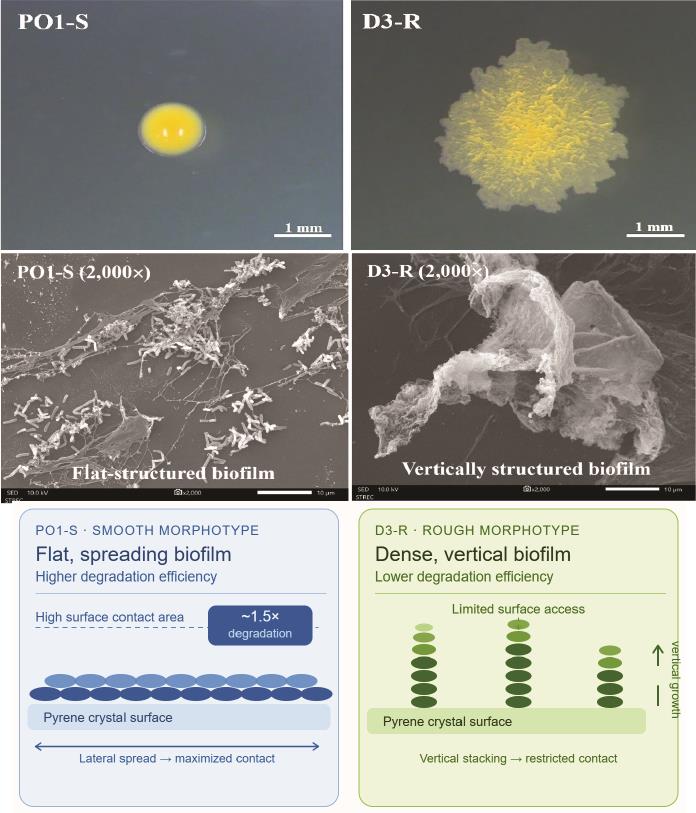
Polycyclic aromatic hydrocarbons (PAHs) are harmful chemicals that can persist in the environment for long periods. They are produced by processes such as burning fuel and other organic materials. Pyrene is one type of PAH that can be broken down by certain bacteria. However, this process can be slow because pyrene does not dissolve easily in water, making it difficult for bacteria to access and use it. Understanding how bacteria interact with pyrene is important for developing more effective methods to clean up contaminated environments. This study investigated how differences in bacterial colony appearance influence the breakdown of pyrene. The researchers compared two colony types of the same bacterial species, Mycolicibacterium parafortuitum. One strain, PO1-S, formed smooth colonies, while the other, D3-R, formed rough colonies. The rough-colony strain was isolated from agricultural soil using a technique that enabled the separation of individual bacterial cells during coculture with the smooth-colony strain. The researchers measured pyrene degradation using chemical analysis and observed bacterial growth patterns on pyrene crystals using real-time imaging. The results showed that PO1-S degraded pyrene approximately 1.5 times more efficiently than D3-R under static conditions, even though both strains possessed the complete set of genes needed to break down pyrene. Imaging revealed an important difference in how the bacteria grew on pyrene surfaces. PO1-S formed thin biofilms that spread sideways and increased contact with pyrene crystals. In contrast, D3-R formed dense, vertically structured biofilms that limited access to the pyrene surface. These differences may help explain why the two strains differed in their degradation performance. Genomic and gene expression analyses also revealed differences that may contribute to these distinct biofilm structures. The findings demonstrate that possessing the necessary degradation genes does not always ensure efficient pollutant removal. Bacterial biofilm characteristics and interactions with contaminants can be equally important. This knowledge could help researchers select or develop bacterial strains with improved performance for the bioremediation of PAH-contaminated environments.
━━━━━━━━━━━━━━━━━━━━━━━━━━━━
🌍 Sustainable Development Goals (SDGs)
🩺 SDG 3: สุขภาพและความเป็นอยู่ที่ดี
ส่งเสริมสุขภาพและความเป็นอยู่ที่ดีของทุกคนในทุกช่วงวัย โดยงานวิจัยนี้เกี่ยวข้องกับการลดความเสี่ยงจากสารเคมีอันตรายและมลพิษที่ส่งผลกระทบต่อสุขภาพและสิ่งแวดล้อม
💧 SDG 6: น้ำสะอาดและการสุขาภิบาล
สร้างหลักประกันเรื่องการมีน้ำสะอาดและการจัดการสุขาภิบาลอย่างยั่งยืน โดยองค์ความรู้เกี่ยวกับการย่อยสลายสาร PAHs อาจสนับสนุนการพัฒนาแนวทางฟื้นฟูแหล่งน้ำที่ปนเปื้อนสารมลพิษ
🌿 SDG 15: ระบบนิเวศบนบก
ปกป้อง ฟื้นฟู และสนับสนุนการใช้ระบบนิเวศบนบกอย่างยั่งยืน โดยการศึกษาความสามารถของแบคทีเรียในการย่อยสลายสารปนเปื้อนช่วยสนับสนุนการฟื้นฟูดินและการอนุรักษ์ระบบนิเวศที่ได้รับผลกระทบจากมลพิษ
━━━━━━━━━━━━━━━━━━━━━━━━━━━━
📚 Reference
Naloka K, Suzuki S, Vejarano F, Sonthiphand P, Pombubpa N, Suzuki K, Suzuki-Minakuchi C, Shintani M, Nojiri H, Pinyakong O. Integrating real-time imaging and transcriptomics reveals morphotype-associated differences in biofilm architecture and pyrene removal by Mycolicibacterium parafortuitum. Bioresource Technology. 2026 Sep 23:135936.