

Highlight Activities 2026: Community responses of freshwater rotifers to concrete substrates and water quality in tropical urban wetlands
This study investigates how small aquatic animals called rotifers respond to different types of wetlands on a university campus in Nakhon Pathom (Thailand). Surprisingly, our results indicate that concrete-lined wetlands actually had a higher density and a greater variety of rotifer species than more natural wetlands. However, this increase is not necessarily a sign of a healthy environment; instead, it likely reflects an ecological imbalance because these artificial habitats favour generalist species that can tolerate poor water quality and lack natural predators like fish or insects. The study also highlights that water temperature and oxygen levels influence rotifers differently depending on the wetland’s construction, with concrete structures potentially intensifying environmental stressors. Ultimately, we recommend that designers of urban wetlands should prioritise habitat diversity and vegetation to support more balanced and stable aquatic ecosystems
Keywords: Freshwater rotifers; Tropical urban ecosystems; Concrete-substrate wetlands; Zooplankton; Bioindicators; Wetland design
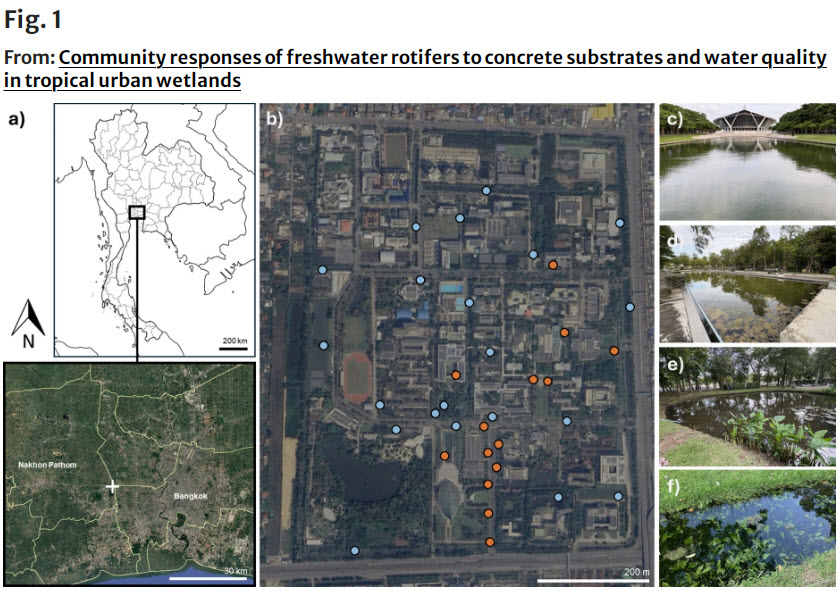
Citation: Sommei, S., Poolpak, T. & Thaweepworadej, P. (2026). Community responses of freshwater rotifers to concrete substrates and water quality in tropical urban wetlands. Hydrobiologia. https://doi.org/10.1007/s10750-026-06122-1